Queertivity
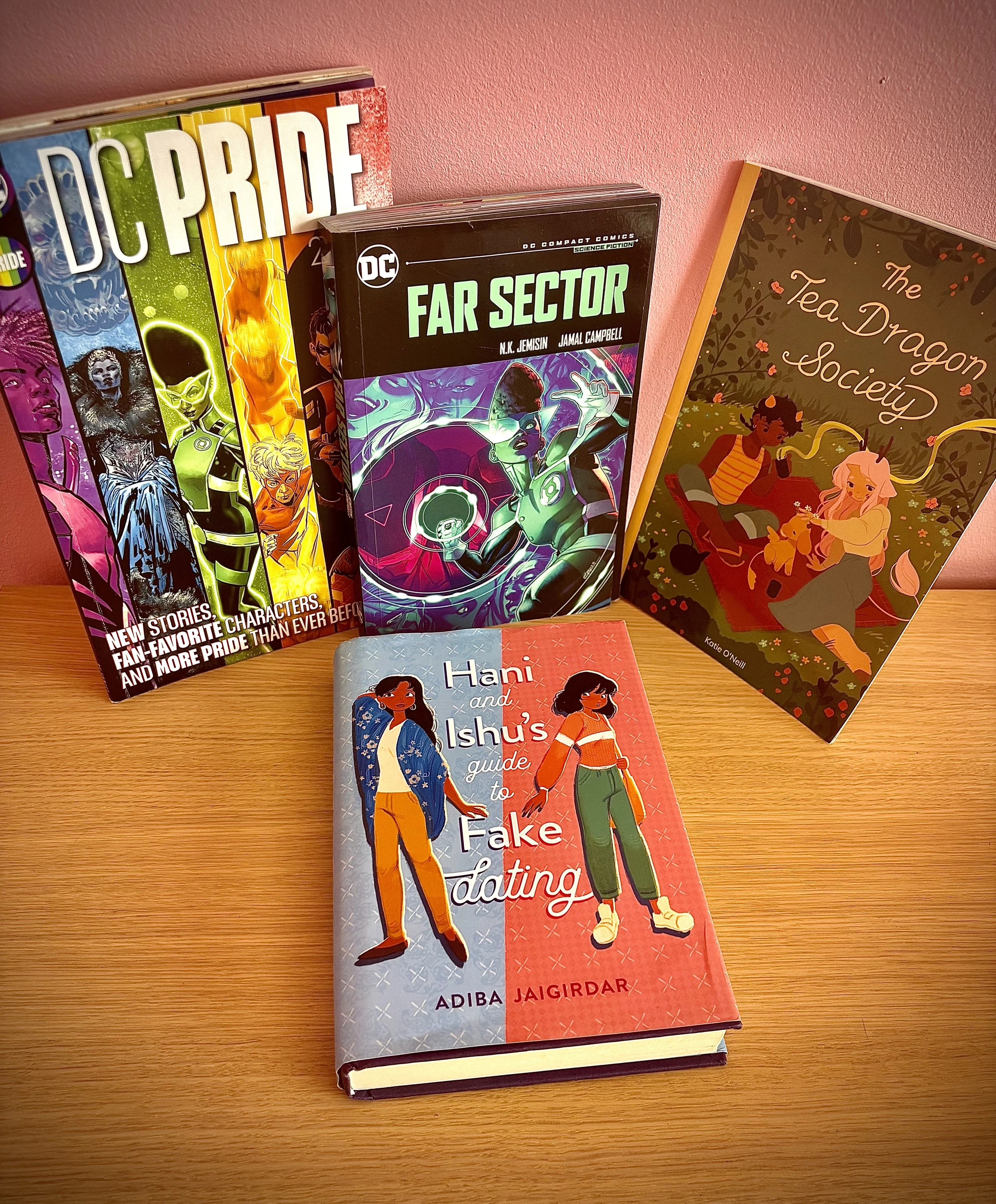
Image Description: Four colorful book covers, three standing upright, and one flat on a table. The first book is titled “DC Pride” with thick vertical stripes, each a color of the rainbow and featuring a character. The second is called “Far Sector” and has a character in a green suit. The third book is “The Tea Dragon Society” which has a colorful illustration of two figures at a picnic. The final book is titled “Hani and Ishu’s Guide to Fake Dating.” On the cover, two characters are featured behind a blue and red background, reaching their hands out towards one another.
This piece is called Queertivity, a play on the words “normativity” which dominates society. My process for taking this picture is seeing what queer books I have in my room and putting them onto a physical display. I wanted to ensure you could see all the books presented, regardless of its length; showing off each book’s front cover accomplished that. Something that all these books have in common, despite differences in genre, characters, and age group, is that they all have queer representation, be it as central or secondary to the main plot.
Growing up, I struggled to find queer representation in the literature I read. A lot of the books on my shelf centered around heterosexual romance—while that isn't necessarily a bad thing, it made me feel lonely. This may not be a sexual desire, but I yearn to see myself in the media I read, especially with media being so important to me as an autistic individual. These books changed that and made me feel seen.
The one in the bottom, Hani and Ishu’s Guide to Fake Dating is purposely set up at the center because it made the biggest impact on me. While the stories upfront all have queer POC, none specifically have my experience as a lesbian Bengali WOC. This book changes that. I no longer had to search for my culture, or my queerness represented in different books: it can now be found in the same place.
While I love queer literature, many queer stories do not incorporate intersectionality. This book was the first time I have seen queerness and culture interwoven into the narrative—particularly of my culture. With this in mind, if you want to learn about my identity as a lesbian Bengali WOC, I ask you to read this book, for the identities that go unnoticed.